
Packaging Published Adobe Captivate Files Together in One
In this video I attempt to answer a question about having multiple Captivate projects with their own assessments linked together using the Multi SCO Packager from Adobe...
In this video I attempt to answer a question about having multiple Captivate projects with their own assessments linked together using the Multi SCO Packager from Adobe. The Multi SCO Packager is included with Adobe Captivate.
Adobe Captivate - Externalize Resources
From time to time you may encounter the following error when attempting to publish your Adobe Captivate project file:
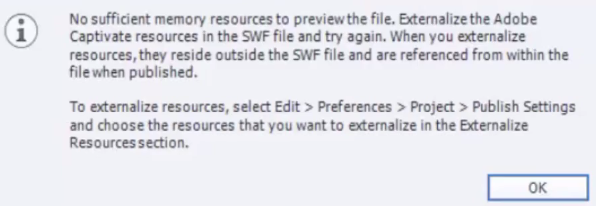
If you haven't run into this before, you may want to check out my video on how to externalize your resources when publishing. Check it out below.
Adobe Captivate 8 - Multiple Interactions in One
In this video, I show you how you can use the built-in features of Adobe Captivate to create a truly unique interaction. In this example, I combine three multiple choice questions to appear as if they are part of a single slide with pop-up characters.
Provide Feedback For Each Answer in Adobe Captivate 8
I thought of this idea this morning to produce a video on how to create a multiple choice, single answer question with unique feedback messages for each answer selected by the learner. I started to put this together and I was convinced I had done a video on this before. I was surprised that I haven't because while this is a relatively unknown feature in Adobe Captivate, it's something that I try to use whenever possible. The reason is that it not only simulates a facilitator answering a question much in the way you would expect them to do so during instructor led training, but it also provides for the opportunity to create a foundations for scenario based learning with branching.
Anyway, take a look at the process and hopefully you can use this technique to improve your eLearning knowledge checks and quiz questions.
Creating Your Own Smart Objects in Captivate 8
In this video, I show you how you can create your own smart objects by essentially tracing any image that you want to make into a smart object.
Exporting and Importing Project Captions and Closed Captions in Adobe Captivate
In my latest video on YouTube, I explain how you can export all your captions and closed captions from your Adobe Captivate project file into a MS Word document. This is a great way to get your hands on all your text, narration (with a little extra work), and closed captioning text for various reasons. Here are the reasons you may want to do this:
To have your text, narration, and closed captions translated into another language - Most people don't have Adobe Captivate on their desktop so sending them the Captivate project file is out of the question, however almost everyone uses MS Word.
To have someone else edit your captions - sometimes you may need to have someone else edit your work. Again, if they don't have Captivate software on their desktop, this isn't going to happen. Exporting to Word just makes sense.
An easy way to ensure that you have consistent use of fonts, colour, font size, and so on - I've run into this where your title is 25 point on one slide, but it's 28 on another. You could edit this in Captivate but you could also use the Format Painter in MS Word for an easy edit to all your content.
Send all text of course content to subject matter experts - This is an easy way for your subject matter experts to follow along with the course and provide suggestions or edits for your consideration. It's not a storyboard, but it's the next best thing.
What the video to learn how to export project captions and closed captions and how to import them back in as well. The video includes a few additional pointers on working with these files.
Google Honours Sally Ride
I opened up Google's search page today and found myself faced with the latest in Google Doodles, a montage of animated images honouring famed astronaut Sally Ride. Sally Ride was the first female American in space and later started her own organization to foster education in children with an emphasis on girls and minority students. She wanted to overcome the issue of kids being turned off by science, technology, engineering and math because society sends a false message about who you have to be to be an astronaut or a physicist like Sally Ride.
Today would have Sally’s 64th birthday. She passed away on July 23rd, 2012 from pancreatic cancer. Check out this video from the animator explaining her process for making the Google Doodle.
How to Import a Photoshop File into Captivate 8
In this video, I show you how you can import a Photoshop file (PSD) directly onto your stage in Adobe Captivate 8. I don't use this feature very often but I can see when it may be advantageous to import images this way. Being able to turn on or off the various layers can add flexibility that you wouldn't have in a merged or flattened image.
Password Protecting a Section of an Adobe Captivate 8 Project
I got a request from one of my YouTube channel viewers. She asked if I could show her a way to password protect a branch of an Adobe Captivate 8 Project. In this video I use a text entry box to store the password into a variable. I then used advanced actions to validate that password and send the user to the appropriate page within the course.
Watch the video below if you want to see how this was done in a little more detail.
Practical Dale's Cone of Learning
Edgar Dale came up with the concept of the Cone of Experience, or the Cone of Learning. The idea is that you can use the cone of experience to figure out what are the best ways for your learners to learn. Here is what it essentially says:
As adults, we generally learn…
- 10% of what we read,
- 20% of what we hear,
- 30% of what we see,
- 50% of what we see and hear,
- 70% of what they say and write, and
- 90% of what we do.
Now it kind of goes without saying that we want to try and get our learners to do something in our eLearning courses. If we simply had them read page after page of content, they are only going to remember a very small percentage of that material.
What this video to see how we can get learners doing something related to a policy document. I could have simply showed them how to get the document from the website, but instead, I have them do it themselves.