
Custom Accordion Interaction with Forced Navigation for Adobe Captivate Project
In this video, I show you how you can build a custom accordion interaction with forced navigation in your Adobe Captivate eLearning project.
In this video, I show you how you can build a custom accordion interaction with forced navigation in your Adobe Captivate eLearning project.

Delayed Next Button Appear Immediately on Your Captivate Slide Revisits
In this video, I show you how to have your next button appear immediately when your learner revisits a slide where the appearance of the next button is delayed until all the content on the slide has played.
In this video, I show you how to have your next button appear immediately when your learner revisits a slide where the appearance of the next button is delayed until all the content on the slide has played. This tutorial uses a simple advanced action and if you plan on using this technic on multiple slides you can save it as a shared action and use it over and over again.
Free Download members of my YouTube channel can download the sample project that goes with this video. If you're a member you can look for it on the COMMUNITY tab of my YouTube channel.

Tabs with Forced Navigation in Your Adobe Captivate eLearning Project
In this video tutorial, I show you how you can create a tabs interaction that includes forced navigation (hidden next button) in your Adobe Captivate eLearning project.
In this video tutorial, I show you how you can create a tabs interaction that includes forced navigation (hidden next button) in your Adobe Captivate eLearning project. This is a great way to chunk your content but keep your slides looking great. It also satisfies your stakeholder's desire to prevent learners from moving forward until they have viewed all the material in this interaction.

Make it Easy for Your Learners to Succeed
I’ve always argued that a simple eLearning design is best for the learner. Instead of spending time figuring out how they can unlock the mystery of quickly getting to the end of the learning, I would rather the learner spent time just learning about the knowledge or skill that is being taught rather than feeling ashamed for lack of success.
I do two things. I design and develop eLearning and I teach others to design and or develop eLearning. In both cases, I encounter people who want to make completing an eLearning course a difficult task for their learners. I know this sounds contrary to what you think an eLearning designer, developer would want to do, but it’s usually the stakeholders or subject matter experts who are concerned with thwarting all the eLearning cheaters by making an eLearning course as difficult to complete as possible. Here are some examples of the roadblocks that I’ve been asked for in eLearning.
Prevent a learner from moving forward unless they answer the knowledge check question
Prevent a learner from moving forward unless they click all the buttons
Penalize a learner by taking points away for answering a question wrong
Force a learner to complete a quiz within a time limit, even when a time limit doesn’t exist on the job
Force a learner to view every slide within the course even if they are already a subject matter expert
It’s been my experience that the more restrictive you make an eLearning course the more programming is required on the developer’s part. I’ve never had any hard data but I have always suspected and argued that a course designed to make it difficult for all the cheaters in the world actually has a negative effect on the vast majority of learners who actually wanted to learn.
It seems that what I anecdotally suspected has been proven by former NASA and Apple engineer and fellow YouTuber Mark Rober. He has far more viewers than I do which is ideal for the experiment in the following video.
Next time you have a stakeholder or SME that wants you to make your eLearning course more difficult or to include a negative outcome for failure, please show them this video. I think you might find that people are far more receptive to a simple and easy to use eLearning design when you focus on making people successful.

Show Delayed Next Buttons Immediately on Slide Revisits in Adobe Captivate
In this Adobe Captivate tutorial, I will show you how you can use a shared action to delay the appearance of your Next buttons across all your slides but make them immediately available on slide revisits.
Has this happened to you? Your stakeholder has asked you to delay the appearance of the Next button on your slides in your Adobe Captivate eLearning project to ensure the learners view all their valuable content. They review the course and then realize that when they return to previously visited slides, they are now frustrated by the Next button's delayed appearance. What's an eLearning developer to do? In this Adobe Captivate tutorial, I will show you how you can use a shared action to delay the appearance of your Next buttons across all your slides but make them immediately available on slide revisits.

Easy Forced Navigation in Captivate 2019 Update 2
Have you ever had to create a click to reveal interaction where the continue or next button remains hidden until the learner clicks all the items? Traditionally this would require multiple user variables to track what has been clicked and multiple conditional advanced actions to do all the programmatic stuff behind the scenes. This was time-consuming and not something new Captivate users found easy to do. This just got super easy with Adobe Captivate 2019 Update 2 (version 11.5).
A common request we get from our stakeholders is the idea of a multi-state object click to reveal but with a hidden continue or next button, sometimes known as forced navigation. This traditionally requires that you create a variable for each button-click to keep track if the learner has clicked on that item, as well as an advanced conditional action that performs the state change but also checks if all the items have been clicked before showing that continue or next button. That means in a six button click to reveal you need six variables and six conditional advanced actions. If you are curious or are still using Adobe Captivate 2017 or older, here is an example of how I used to create such interactions:
Hide the Next Button in Captivate Until Learners Do Something First
Today there is an easy way to do this with Adobe Captivate 2019 version 11.5 or newer. Even with this smooth workflow, there are some rules you must follow. I've attempted to write them out to make this easy for you to do on your own.
Step 1. Label Your Slide
First, you must label your slide multistate. Don't worry if your on-screen title needs to be something else. This lets Captivate 2019 know that this sort of interaction is going to be on this slide.
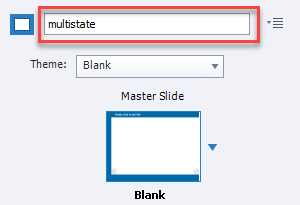
Slide Label in the Slide Properties Inspector
Step 2. Label Your Multi-state Object
Second, you must label your multi-state object ms_ followed by the name you wish to give this interaction. For example, I'm calling mine ms_impacts. Your multi-state object can contain additional objects as mine does. I have a smart shape with text, and with each state, I've also included an image. Both the smart shape with text and image change with each click.
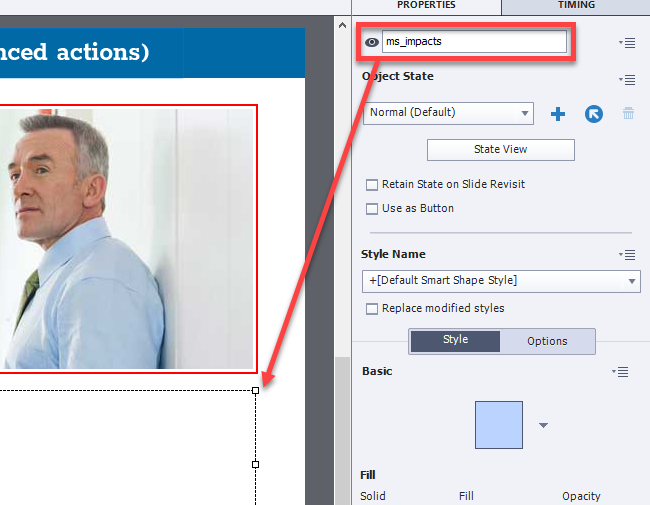
Multi-state object label
Step 3. Label Your Buttons
You must create the same number of buttons as you have other states in your multi-state object. These need to be precisely labeled according to the name of all the states in your multi-state object. In my example, I have the following states in my multi-state object.

The state names in the multi-state object
I created six buttons each set for "no action" to represent all the states in ms_impacts. Label each shape button <interaction name>_<state name>. In other words, I labeled my first button impacts_workgroup_conflicts, and so on.
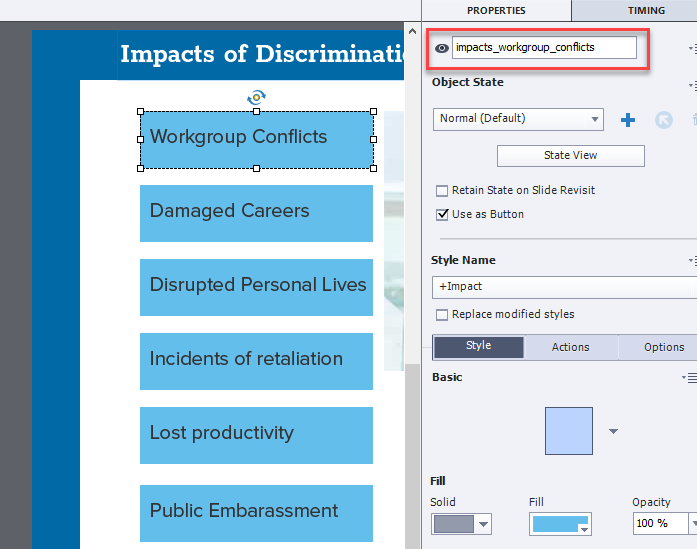
Labels for the shape buttons
Step 4. Label Your Hidden Next Button
Lastly, make sure you have a next or continue button that you have labeled <interaction name>_completed. For my example, I'm using an arrow button to advance, and I've selected the Not visible in output icon and labeled it impacts_completed as you can see below.
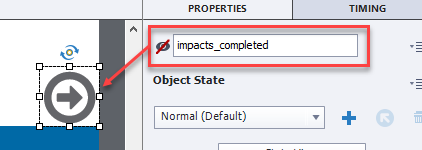
Label your hidden next button
If you follow the correct labeling conventions of all of these items, this should work exactly like the more complicated interactions we used to create in the past. Both interactions behave the same, but the difference is that this method takes only minutes to create, whereas the older, more complicated process took longer. You can have as many of these interactions within a single project as you wish, so long as you follow the naming conventions. I can't see why I would use the conditional advanced actions method when I now have such an easy process.
Exclusive to my Patreon subscribers you can download the project file used in the creation of the this video.